
A quieter and more affordable alternative for your 1911 Pistol?

Among the daily barrage of emails, one that caught my attention advertised .45 ACP rounds on sale “for only $24.50 per box”. After lamenting the ever-increasing costs of ammunition, I was motivated to inventory my personal stash. Some relief there. Turned out I was in decent shape, good enough that I was inspired to punch large holes in cardboard targets.
To prepare, I packed the range bag with three boxes of .45 ACP handloads, a 5-inch Kimber Model 1911 Eclipse, a holster and related gear. The other key requirement was a break in our winter weather. But northern New England winters can be fickle. Despite the sunny and balmy (less arctic) forecast, the morning’s first rays revealed two inches of fresh snow – just enough to cover a treacherous icy stretch on the long dirt road leading to the range.
Add to those difficulties recovering fired cases. Looked like it was time for an abort – until I remembered a .22 LR conversion kit languishing the safe.
In short order, the Kimber’s entire slide assembly was replaced by the rimfire unit, its magazines were exchanged, and the .45 ACP rounds were swapped for .22 LR cartridges. Everything else; holster, mag pouch, etc., remained in the bag. The entire metamorphosis required only a few minutes, and put me in great shape for a session on the backyard range.
By 0900 the Kimber was spitting out fired cases with few concerns about their recovery. From a bust to a fun morning, with minimal impact on my wallet, and a dividend of relevant practice.
1911 Conversions Kits Vs Complete .22 LR Pistols
A .22 rimfire handgun that operates and handles like its centerfire counterpart has advantages. Some, like Ruger’s .22 Government (a spinoff of their popular Mark Series) are functionally similar to a Model 1911. Several relatively inexpensive 1911 clones come even closer, however, we often get what we pay for.
An entire pistol built to sell for around the same cost as half of one? Safe bet corners have been cut related to metallurgy, etc. If purchased for use as trainer, there may also be subtle differences related to its trigger and ergonomics.
Install a rimfire upper to your existing 1911’s frame though and these concerns become moot – assuming the conversion actually works. Some can be fussy regarding ammo preferences but, once the issues are ironed out, a kit can be the ticket to affordable practice.
And, federally, an un-serialized conversion assembly is considered a collection of parts, meaning it can be shipped directly to the purchaser. As such, it could also circumvent onerous restrictions in locales with extraneous red tape to include purchase limits.
Designs, Past & Present
Centerfire-to-rimfire conversions are far from a new idea. Regarding 1911 pistols, Colt’s .22 ACE was both a forerunner and the go-to-choice for several decades. Over the years, complete .22 LR pistols and conversion units have been cataloged by Colt. Unlike more recent designs, their steel slides closely mirrored the handling qualities of a centerfire Model 1911, and recoil was even present to some extent, a product of their design.
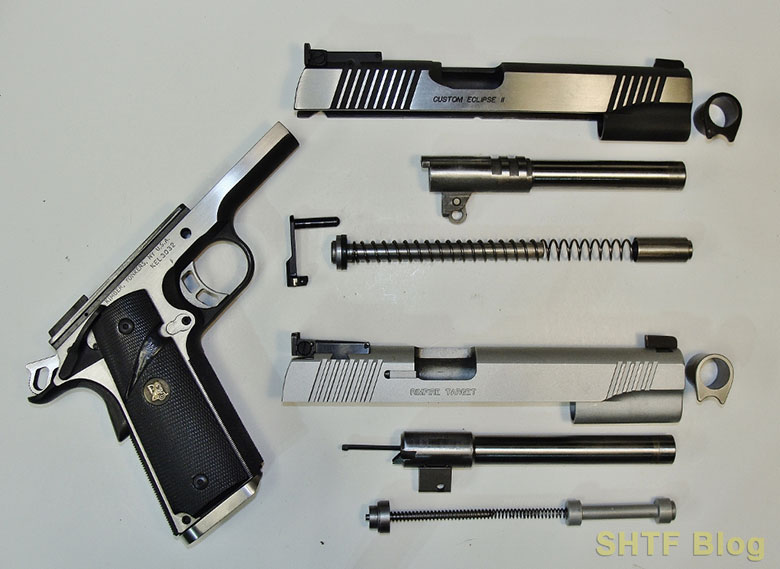
To gain positive function with lower-impulse .22 LR cartridges, the heavy steel slide received an energetic shove through a separate “floating chamber”; a kicker-piston, of sorts. At one point I owned the Colt Conversion Unit shown in the photo. It ran reliably with some (but not all) target loads and was surprisingly accurate despite its separate chamber. As a plus, because of its steel slide, 1911 functions were preserved to include the last shot, slide-lock feature.

Contrast this to the present aluminum .22 rimfire 1911 conversions that function as straight blowback designs. The lighter slide provides sufficient mass to contain initial pressures (per other .22 LR semiautomatic designs), but still permit proper cycling. These less complex 1911 systems are easier to produce, and also simplify the cleaning process – a useful advantage given the fouling deposited by .22 LR ammunition.
The downsides (from a training/practice perspective) are the different feel, and elimination a slide-lock feature. The latter prevents inevitable peening (distortion) of the soft aluminum notch during its capture by the hard steel slide-stop. The notch is still present though, for manual engagement of the stop during unloading and clearance.
Lock-back is cancelled through the elimination of the engagement shelf on the magazine’s follower. The negative: Chances for unwelcome dry fires increase exponentially. More about this shortly.
Meanwhile, most of today’s dedicated .22 LR 1911 pistols follow similar designs. Although they’re actually facsimiles, the slide-lock feature may be maintained through a magazine with a stop-catch. Which raises concerns about the endurance of their slides. For a while Kimber cataloged complete .22 LR 1911s but, like their kits, a lock-back feature was absent.

The Kimber .22 LR Conversion
Kimber currently catalogs standard five-inch, and four-inch “Commander” sized kits, in dark and silver finishes, with fixed (4”) or adjustable sights. My Rimfire Target Conversion Kit is a 5-inch version, however, because its dust cover is extended (see photos), it’ll supposedly fit 4-inch 1911s.
Finished to compliment stainless (or bright aluminum) frames, its slide has “Bo-Mar” type adjustable target sights. The kit included one plastic 10-shot magazine sans a thumb-assisted loading button. No slide-stop though. The rimfire assembly installs with the pistol’s original stop.
Kimber America | Rimfire Target Conversion Kit
Fitting Notes
I purchased my kit from its original owner after he sold its host pistol, another Kimber 1911. He claimed it shot “great” and ran reliably with .22 LR high-speeds. Advertised by Kimber to “fit most 1911s”, it installed on the frame of my Eclipse without any problems. But given the millions of 1911 frames produced by a number of manufacturers, others may not be as lucky.
I tried it on a 9mm single-stack STI (now Stacatto) frame, machined for a ramped (supported) chamber. The Kimber’s rimfire barrel is similarly designed but, because it extends further rearward to overlap the .22 LR magazine, the frame-cut was a non-issue. The conversion slid on to the STI, but felt a bit “sticky” so I quit while I was ahead.
Overall, the sometimes elusive combination of fit, function and accuracy often boils down to tolerances.
Installation
As noted above, this particular conversion kit was earmarked for a .45 Kimber Eclipse. And because it was fitted with a full-length guide rod (per the photo), the exchange was a simple process.
Kimber America | Eclipse Custom II (LG)
After verifying the pistol was unloaded (magazine removed), the slide was retracted until its takedown notch coincided with the slide stop’s retaining ear. At that point, the stop could be wiggled free, allowing the entire slide assembly to be drawn forward, off the frame. Because the .22 assembly is also self-contained, its installation follows the same process in reverse. No fiddling with energetic recoil springs, recoil plugs, or barrel bushings. Just add the .22 LR magazine and some ammo.

Weight
According to my scale, the rimfire assembly weighs 15-ounces with its empty 10-round magazine.
The equivalent .45 ACP Eclipse assembly weighs 21.3 ounces (8-round Wilson mag). Its tricked-out frame and slide-stop add 19 additional ounces, for a total weight of 40.3-ounces.
The same frame with the conversion kit installed, range-ready, weighs 34-ounces, a substantial and noticeable difference, both good and bad. Feels great in the hand and carries nicely, but compromises training to some extent. Loaded with 8 rounds each (40 & 230-grain bullets), add 1-ounce, or 6-oz. more.
Range Results

The Kimber’s slide displays “Rimfire Target”. Optimistic perhaps, but many owners report excellent accuracy – with a potential wrinkle: Function boils down to a balance of slide mass vs springs and the thrust imparted by the cartridge. Optimum performance could be elusive, as illustrated by a favorite target load…
Federal’s .22 LR 40-grain Gold Medal Target (#7118) has proven accurate in a number of my rimfires but, like some others, it didn’t have enough oomph to reliably cycle the slide. This led to some empty-chamber “dry-fires”. Too bad because, off sandbags from 25 yards, 5-shot groups averaged around 1 ¼ -inches (see photos).
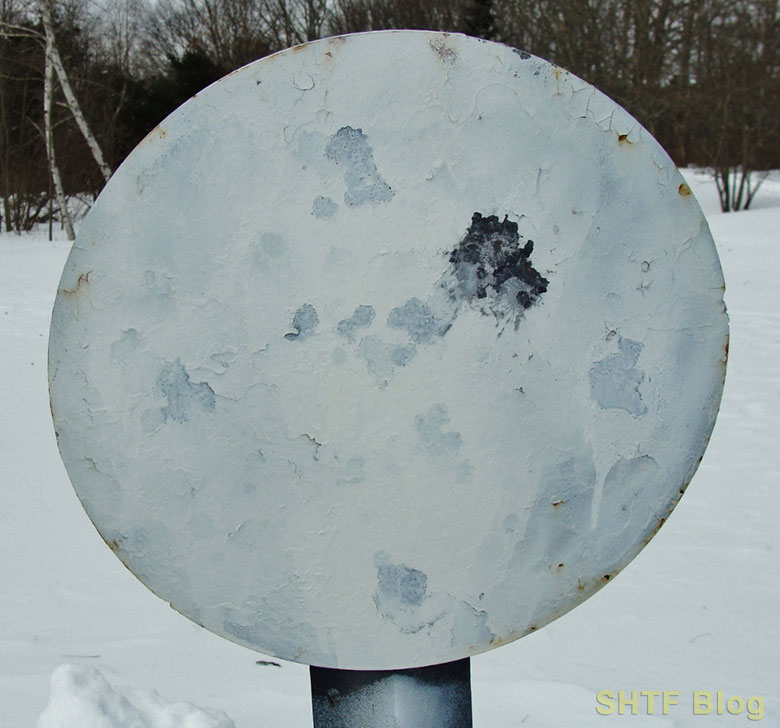
The good news: During previous testing, per Kimber’s recommendation, CCI Mini Mags produced excellent accuracy. The representative 1-inch group pictured on the 25-yard steel plate dates to the initial test. Because it’s a pricier load (although still a lot less than .45 ACP) I tried several more affordable alternatives during this go-around.
Remington’s plated HP Golden Bullets fed consistently but produced occasional misfires despite solid indents (no surprise). Lead RN Thunderbolts ran near 100%, but a few caught nose-down. Same for Winchester Super-X HPs. Not shown are the results of Federal’s 36-grain 550-count Value Pak (pictured among the others).
Like the GMTs, this load wouldn’t consistently cycle the slide. From this collection, five-shot groups (25 yards) averaged around 2-inches – good enough for entertainment on a dueling tree!

So, yup, conversion kits can be fussy (as can .22 LR accuracy in general). Scratch .22 Shorts or CB Caps. CCI’s .22 LR “Quiets” could be manually cycled with some success, but all are fairly noisy in conventional handguns.
.22 Shorts Ammo – A Rimfire Shooter’s Guide
More About Reliability
Some problems could be attributable to tolerance stacking. Others, such as failures-to-feed, could be the result of short-cycling (per the above milder loads). Those I encountered may have been exacerbated by my pistol’s stout hammer spring. Nevertheless, it’ll remain as is to ensue 100% reliability with .45 ACP loads.
Other stoppages could tie in with maintenance or lubrication. Because the rimfire’s recoil spring is much lighter, rounds feed with less gusto. For this reason, lubrication is essential. Kimber recommends FP-10, but I used liberal doses of Break-Free. Temps were in the upper 30s, chilly enough to stiffen up some lubes (and grease). Fouling makes matters worse so, to give the conversion a fair shake, testing began with a squeaky-clean pistol.
If reliability does begin to suffer, the cure could be a thorough cleaning. Due to the small diameter of the cartridges, the rimfire unit kicks out empties via its own ejector – the long springy arm. A sluggish slide can slow ejection and/or the feeding of fresh rounds from the magazine. Mine looked grubby enough after 200 rounds to warrant a cleaning. On a positive note, disassembly is fairly simple.

Managing Dry-Fires
After disassembling my kit for cleaning, I happened to notice a tiny indent on the barrel’s chamber’s lip. Located at 12:00, it coincided with the firing pin. Could this be the cause of some feeding issues? To find out I tried chambering samples of the offending cartridges. Holding the barrel muzzle-down, they all dropped in (and fully chambered) without hesitation. So far, so good, but I’ll still try to avoid dryfires by counting shots.
Training-wise, there are arguments for or against this, but I remain an advocate. To that end, its magazines are also loaded with only eight rounds – same as my .45’s. Using this strategy, you could insert a dummy .22 LR snap-cap or two before loading live cartridges. A click should indicate it’s time to reload – but treat it as a misfire for safety’s sake.
A-ZOOM Orange Value Pack Snap Caps 22LR 20PK (midwayusa.com)
An extra Brownells magazine on hand (possibly designed for another system) locked the slide open but wouldn’t reliably feed more than 7 rounds. Any further use will be sparing, a concession to possible slide damage. Which returns us to the possibility of a deformed chamber mouth. A ray of hope here: Because it’s common rimfire ailment, if nipped in the bud, a cure is available through Tandemkross.
“ChamberMade” Repair 22 caliber short, long, or long rifle chambers (tandemkross.com)
Parting Shots
Kimber isn’t the only conversion provider. Nor are these units limited to Model 1911s. Rimfire conversions are sold to fit Glocks, Berettas and Sigs, etc. – some by their manufacturers. But the 1911 line is especially diverse with conversions from Advantage Arms, Marvel Precision, Tactical solutions and others. Some feature steel slide inserts designed to maintain slide-lock. Others accommodate optics.
By comparison, my Kimber kit is more basic – but it will fit my existing holsters & mag pouches – a money saver. Available as Compact Kit (fixed sights), or Target Kit, it lists for $340. And possibly, the cost could be amortized via ammo savings. The above sale-priced .45 ACP Blaser (brass cases) ran $24.50 per box. The same ad showed .22 LR Blaser going for $3.50 – seven 50-round boxes for the same cost!

Other benefits? Beyond the training and practice aspects, add a conversion to a survival or bug-out kit and you could harvest small game. Adjustable sights can be sighted in for specific loads, and both assemblies will hold their zeroes. Maybe pack a few spare parts (like a spring-plug or slide stop) with an extra magazine or two. The weight of the Kimber kit with 100 rds of .22 LR Thunderbolts works out to around 27-ounces.
Ammo Weight Charts: Handgun, Rifle, Shotgun
Or, on a less serious note, pack several boxes. Then have a blast plinking cans or metal spinners, without going broke. For more about the 1911 system and handguns in general, here’s a link to Handguns: A Buyer’s and Shooter’s Guide:
- Markwith, Steve (Author)
- English (Publication Language)
- 418 Pages - 07/13/2019 (Publication Date) - Prepper Press (Publisher)